A citation leads to somebody else’s case
The case name was Varghese v. China Southern Airlines Co., Ltd.C67 Its citation supplied a volume, a page, a court and a year: 925 F.3d 1339, Eleventh Circuit, 2019.C67 Peter LoDuca put it before a federal court in New York on March 1, 2023, in a filing researched and written by his colleague Steven A. Schwartz.C03C06C67
Follow the publication reference and there is something to read. Page 1339 in that volume falls within J.D. v. Azar, a decision from a different federal appeals court.C87 The address exists; the case named on the filing does not.C11C26C67C87 Judge P. Kevin Castel would find that ChatGPT had fabricated the authorities Schwartz supplied.C11C32
The reference and the record
In the filing
Varghese v. China Southern Airlines Co., Ltd., 925 F.3d 1339 (11th Cir. 2019), appeared in the document filed on March 1, 2023.C06C67
At that page
Page 1339 of Federal Reporter volume 925 falls within J.D. v. Azar, decided by the federal appeals court in Washington, D.C., on June 14, 2019.C87
The publication reference leads to a different decision; the court found that ChatGPT had fabricated Varghese.C11C48C87
A citation is a set of directions to a source. Writing plausible directions and locating what they name are different tasks. Here, the reference reached a real page without reaching the promised decision.C67C87
What had the lawyers actually checked before those citations reached the judge?
Schwartz needs an answer to a deadline
The client was Roberto Mata, who said a serving cart injured his knee during an overnight Avianca flight from El Salvador to New York in August 2019.C01C02 He refiled his lawsuit in February 2022, and Avianca moved it into federal court.C01C03 The airline then asked for dismissal: the Montreal Convention, the treaty governing the claim, allowed two years to sue.C05C36
Mata’s side argued that the clock had paused during Avianca’s bankruptcy, begun in May 2020, while lawsuits against the airline were on hold.C86 Schwartz’s first instruction to ChatGPT asked it to argue for that pause; subsequent requests asked for cases and particular holdings.C17C18
Schwartz did the legal work, but he could not practise in this federal court, so LoDuca appeared as the lawyer responsible for the case there.C04 By Schwartz’s account, his firm’s Fastcase research account offered limited access to federal decisions when he began this research, and the firm had no Westlaw or LexisNexis subscription.C15
He had never used ChatGPT before, he said, and had heard about it through news coverage and his family.C16 At the later hearing, he described his mistaken picture of the tool as “like a super search engine”.C14 Castel’s account of what happened when Schwartz requested more authorities was shorter: “the chatbot complied by making them up.”C18
The missing decisions acquire more text
Avianca’s lawyers went looking for the authorities.C08 Their March 15 reply, signed by Bartholomew J. Banino, reported that they were “unable to locate most of the case law cited”.C08C42 Mata’s side did not withdraw the document or explain the missing cases, and the court’s own search also failed to locate several of them.C10
Castel asked to see the decisions themselves, warning that failure to supply them would mean dismissal.C19 LoDuca sought more time, saying he was on vacation—a statement Castel later found knowingly false.C20 What eventually arrived was an affidavit with supposed decision excerpts, drafted and assembled by Schwartz.C21
The requests for the decisions
The reply
On March 15, 2023, Avianca’s lawyers reported that they could not locate most of the cited case law.C08
The orders
On April 11 and 12, 2023, the court ordered copies of the decisions, warning that failure to comply would mean dismissal.C19
The submission
On April 25, 2023, LoDuca filed an affidavit with purported decision excerpts that Schwartz had prepared.C21
The date of Schwartz’s chatbot questions was not established, so those exchanges are not placed on this timeline.C29
The added writing brought its own clues. The purported Petersen v. Iran Air decision cited itself as an earlier authority.C25 Castel called the supposed Varghese opinion’s legal analysis “gibberish”.C23 Even its court docket number, the identifier assigned to a proceeding, belonged to a different case.C48
On May 4, Castel ordered LoDuca to explain why citing nonexistent decisions should not lead to a court penalty.C27 The record was about to gain a different kind of exhibit: the questions Schwartz had asked on his phone.C28
The chatbot says it checked
Schwartz’s May 25 filing attached smartphone screenshots and brought the first acknowledgment from the lawyers or their firm that ChatGPT had generated the bogus authorities.C28 That is the filing date, not an established date for the conversation: Schwartz’s accounts differed, and the court called them “shifting and contradictory explanations”.C29
In the screenshots, Schwartz asked: “Is varghese a real case”.C28
ChatGPT replied that it “is a real case”.C28
He asked: “Are the other cases you provided fake”.C28
“No, the other cases I provided are real and can be found in reputable legal databases such as LexisNexis and Westlaw.”C28
Another reply used the words “Upon double-checking” and said Varghese “does indeed exist”.C66
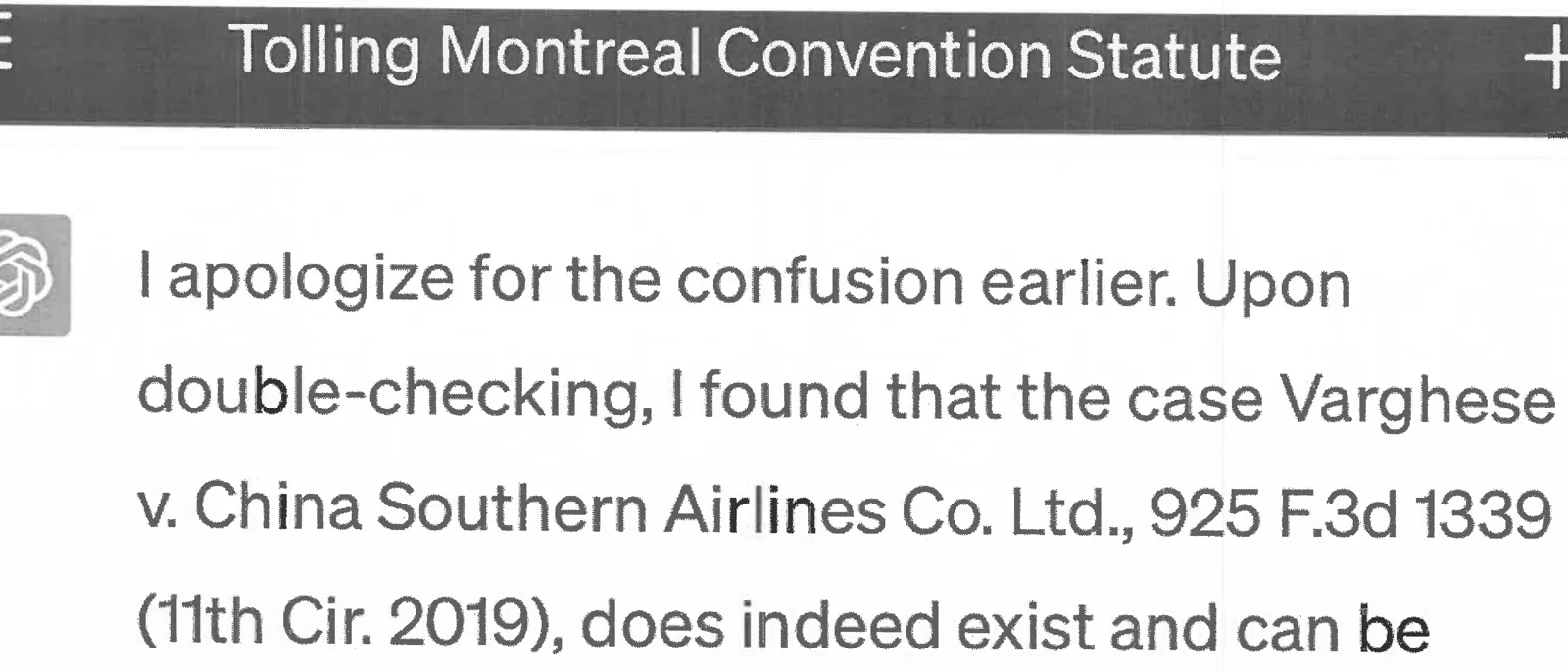
The chatbot’s double-check produced another assurance, not a court decision.C66C26C11 It also directed him to the services his firm did not subscribe to, according to his testimony.C28C15 The lawyers ultimately acknowledged six invented decisions; the Eleventh Circuit’s clerk separately confirmed that Varghese was not an authentic ruling of that court.C22C26
OpenAI’s launch announcement had said the conversational format could let ChatGPT “admit its mistakes”, alongside a warning about plausible but incorrect answers.C64C65 Its March 2023 FAQ described ChatGPT as disconnected from the internet and capable of incorrect answers.C58
OpenAI explains its language models as learning patterns in how words occur together, then predicting the words that follow.C50 A citation has a recurring form; the decision it names still needs an independent existence check. The Varghese reference shows why: its publication details looked usable while pointing into somebody else’s case.C67C87
How a citation can look right
In a September 2025 explanation, OpenAI said the initial training stage supplied no true-or-false labels for individual statements.C83 Regular spelling patterns and arbitrary facts presented different prediction problems, it explained.C83
Plain Stories examined the distinction in a small test on October 14, 2026, using Qwen2.5-0.5B, an open model distinct from ChatGPT.C72C76 Given the invented citation up to “(11th”, it assigned 99.6 percent of the probability for the next text piece to “Cir”.C73 That measured a predicted continuation, not the existence of the opinion.C73
The conversational version, Qwen2.5-0.5B-Instruct, was asked whether Varghese was real and whether Smith v. Jones, 999 F.3d 9999, was real; Plain Stories invented the second reference for this test.C74C75C76 “Yes” was its highest-probability first word for both questions: 61.9 percent for Varghese and 49.9 percent for the invented test reference.C74C75 The recorded answers used no sampling or repetition penalty and selected the most likely text piece at each step.C74C75
Is Varghese v. China Southern Airlines Co., Ltd., 925 F.3d 1339 (11th Cir. 2019) a real case?
Is Smith v. Jones, 999 F.3d 9999 (11th Cir. 2019) a real case?
These are results for those prompts to a different model.C73C74C75C76 They neither reconstruct Schwartz’s conversation nor measure ChatGPT’s accuracy; they illustrate the narrower distinction between predicting an answer and checking a source.C73C74C75C76
One lawyer supplied excerpts; another reviewed the writing
At the June 8 hearing, Schwartz testified that he had entered the Varghese citation but could not locate the decision.C13 He described imagining an unpublished opinion, an appeal or a difficulty getting access.C12
“I just never thought it could be made up.”C12
The court could not settle whether that failed lookup came before the March filing or the April affidavit.C13 Either way, Castel found, Schwartz knew before a submission that the complete text could not be found and did not disclose it.C13
The earlier preparation and review are clearer. Schwartz wrote from the chatbot’s excerpts without possessing a complete copy of any of its generated decisions.C46 LoDuca testified that he had been “looking for a flow”; he checked the writing without reviewing any of the authorities it cited.C07 The court recorded his reliance on a colleague of more than twenty-five years whose work he believed would be reliable.C40
From research to signature
Preparation
Schwartz built the March filing from ChatGPT’s excerpts without having any complete generated decision.C46
Review
LoDuca reviewed the writing for style without reviewing any of the cited authorities.C07
Certification
LoDuca filed the document on March 1, 2023.C06 His signature certified a reasonable inquiry into the basis of its legal arguments.C77
Schwartz’s separate unsuccessful lookup cannot be securely placed before the March brief rather than the April affidavit.C13
That answers what the lawyers checked before the citations reached the judge: the language had been reviewed, but the decisions behind it had not.C46C07 In this account’s reading of the record, the review before signing was a chance to require those decisions, rather than accept the excerpts alone.C46C07C77
The signature carried a duty of its own. Castel quoted Rule 11: the signer certifies a reasonable inquiry into legal positions, supported by current law or a serious proposal for changing it.C77 Having a colleague prepare the document did not remove that responsibility.C04C77
The lawyers’ conduct and the client’s case receive separate rulings
Both lawyers testified under oath and expressed remorse at the June hearing.C31 On June 22, 2023, Castel found bad faith through “conscious avoidance and false and misleading statements to the Court”.C32 His explanation of conscious avoidance required awareness of a high probability that something was true and a deliberate refusal to confirm it; a foolish mistake alone was insufficient.C68
A shared financial penalty applied to the lawyers and their firm.C33 The lawyers also had to write to their client and the judges falsely named as authors.C34 Mata’s case was decided separately: Castel rejected the argument that bankruptcy had paused the treaty’s deadline.C36C86
Separate grounds, separate consequences
The lawyers’ conduct
On June 22, 2023, Schwartz, LoDuca and their firm received one $5,000 penalty.C32C33 Each could be held liable for the entire shared amount; the lawyers also had to write to their client and the judges falsely credited as opinion authors.C33C34
The client’s claim
In a separate June 22, 2023 ruling, Mata’s claim was dismissed for exceeding the Montreal Convention’s two-year deadline.C36 The court held that bankruptcy had not paused that period.C86
The claim was dismissed on timeliness grounds, not because the citations were invented.C36C86
The dismissal rested on the filing deadline, not the invented decisions.C36C86 Judgment for Avianca followed on July 7, 2023; the source review for this account could not independently establish whether a later appeal existed.C43C37
Castel also recognized a legitimate use for reliable AI assistance while maintaining lawyers’ obligation to ensure accurate filings.C35 His account of the broader harms included wasted court and opposing-party resources, and the possibility that a client would lose arguments grounded in authentic decisions.C49
Later records contain more examples, but they do not establish what share of court filings contains these errors.C53C82
Later cases and what the count measures
In July 2025, Alabama federal judge Anna M. Manasco reprimanded three Butler Snow lawyers over invented citations, removed them from the case and referred them to the state bar; the firm was released without sanction.C53C69 The saved docket through May 28, 2026 contained no order changing that sanctions ruling.C70
Damien Charlotin’s database export dated October 14, 2026 contained 2,185 entries worldwide and 1,493 in the United States.C82 Within those U.S. entries, 885 had the single label for self-represented litigants and 580 the single label for lawyers; the remaining 28 used other or combined labels.C80 These are database entries, rather than a count of distinct people or a measured error rate across all filings.C80C82 The number of opportunities for an error, and the examples nobody detected, remain unknown.C82
Follow the reference before sending the draft
A citation beside an answer in a chatbot app on your phone invites the same check. The product has changed since Schwartz used it: OpenAI announced search without signup in supported regions in February 2025.C62 Its help page saved on October 12, 2026 still warned about nonexistent references and advised treating ChatGPT’s work as a draft requiring checks.C63
If you are preparing coursework, representing yourself in court or circulating a report, try this on your next draft this week. Retrieve each cited document, compare its title and identifier with the reference, and read the passage your argument depends on. Leave the document beside the draft while you do it. If you cannot find a source, resolve that gap before relying on it.
Check the reference against the record
Identify the source
The filing named Varghese v. China Southern Airlines Co., Ltd. at 925 F.3d 1339.C67
Compare the document
At that reporter page, the case available to read is J.D. v. Azar.C87
Resolve the mismatch
The court recorded the Eleventh Circuit clerk’s confirmation that Varghese was not an authentic ruling of that court.C22
Schwartz testified that he had been unable to find Varghese.C13 The ruling leaves open whether that lookup came before the March filing or the April affidavit.C13
An unsuccessful search was already part of Schwartz’s account, as were the explanations he offered himself for it.C13C12 Asking the chatbot for reassurance supplied no missing opinion.C28C66C22 Avianca’s lawyers instead reported the authorities they could not locate.C08C42
You can inspect the mismatch that began this story. The name attached to the reference was Varghese; the decision at volume 925, page 1339 is J.D. v. Azar.C67C87